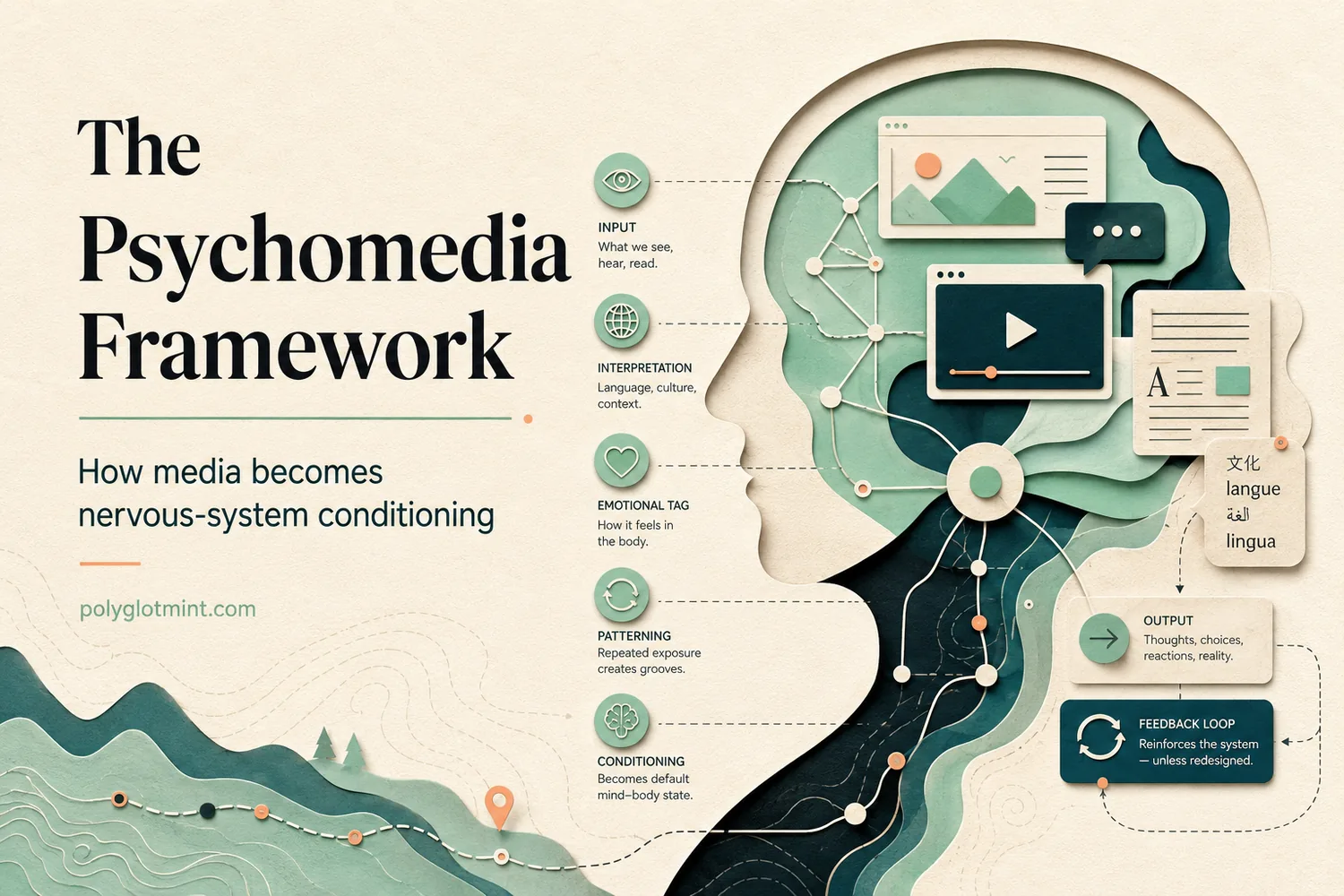
The Psychomedia Framework
How media becomes nervous-system conditioning
Abstract
Psychomedia is the psychology of media, trauma, and control.
It studies how media environments shape perception, emotion, identity, memory, desire, and collective awareness over time. The Psychomedia Framework gives structure to that field by asking how media becomes more than information. How does a repeated image become an association? How does a narrative become belief? How does entertainment become conditioning? How does a culture learn to normalize its own injuries?
At its center is one question:
What happens when the abuser is not a person, but an entire system?
This article introduces the Psychomedia Framework as a field blueprint: a model for studying how symbolic environments enter the nervous system, reproduce trauma, shape behavior, and construct reality at scale.
Definition
Psychomedia is the study of how media, trauma, language, and control interact inside human consciousness.
It examines how stories, images, sounds, symbols, technologies, rituals, institutions, and social systems shape the way people feel, remember, desire, deny, imitate, and believe. It treats media not only as communication, but as psychological environment.
A media system does not simply show the world. It trains the body to respond to the world.
It can teach fear. It can teach craving. It can teach shame. It can teach obedience. It can teach beauty, attention, empathy, and repair.
Psychomedia studies all of these possibilities. Its purpose is not to reject media, but to understand what media does to the nervous system over time.
The Core Question
In interpersonal abuse, control often appears through familiar patterns: gaslighting, contradiction, love-bombing, isolation, intermittent reward, humiliation, fear, dependency, and emotional confusion.
Psychomedia asks what happens when these tactics scale. What happens when they are no longer limited to one relationship, but embedded in platforms, advertising, celebrity culture, political messaging, entertainment, and algorithmic feeds?
What happens when entire populations are trained through repetition to distrust their perception, crave their own overstimulation, confuse performance with intimacy, and mistake emotional manipulation for meaning?
This is the starting point of the field. Psychomedia proposes that many forms of modern media do not merely reflect collective trauma. They rehearse it, aestheticize it, monetize it, and return it to the public as culture.
The Three Layers of Psychomedia
The Psychomedia Framework operates through three interlocking layers: cognitive, affective, and symbolic.
The Cognitive Layer
The cognitive layer studies how media shapes perception, language, attention, and belief. This includes repetition, framing, suggestion, semantic drift, algorithmic reinforcement, euphemism, doublespeak, and the slow reshaping of what a person considers normal.
A phrase can become a frame. A frame can become an expectation. An expectation can become a worldview.
The cognitive layer asks: What does this media teach the mind to notice? What does it teach the mind to ignore? What words does it repeat until they feel natural? What meanings does it make easier or harder to think?
The Affective Layer
The affective layer studies how media regulates, dysregulates, or captures emotion. Media does not only inform people. It moves them. It creates states: outrage, longing, envy, urgency, arousal, shame, nostalgia, despair, belonging, fear, and relief.
Repeated long enough, these states become familiar. Familiarity can begin to feel like truth.
This is why Psychomedia studies emotional dependency. A person may not believe a media system consciously, but the body may still return to it because it provides stimulation, rhythm, identity, or temporary regulation.
The affective layer asks: What emotional state is being rehearsed? What feeling is being rewarded? What wound is being activated? What dependency is being created?
The Symbolic Layer
The symbolic layer studies how images, myths, archetypes, aesthetics, rituals, and visual patterns encode meaning. Symbols can bypass direct argument. They organize feeling before thought. They can make an ideology feel sacred, a product feel redemptive, a celebrity feel intimate, or a system feel inevitable.
The symbolic layer asks: What symbols are being repeated? What associations do they create? What myths do they activate? What kind of reality do they make emotionally believable?
Together, these three layers form the basic Psychomedia model:
media enters perception, alters state, and becomes symbolic reality.
From Media Effects to Media Mechanisms
Traditional media psychology often asks what media does to audiences. Psychomedia asks how.
It is not enough to say that media influences behavior, mood, politics, beauty standards, or self-image. Psychomedia studies the mechanism of influence: the repeated patterns by which media becomes emotional training.
The question is not only: Did this content affect people? The deeper question is: Through what pathway did it become part of the nervous system?
Did it work through language? Through fear? Through desire? Through repetition? Through humiliation? Through identification? Through symbolic association? Through social reward?
Psychomedia turns media analysis into mechanism analysis.
Areas of Inquiry
Psychomedia investigates the places where media, trauma, language, and control overlap.
Trauma Repetition in Advertising and Film
Many media forms replay unresolved emotional wounds: abandonment, inadequacy, humiliation, fear, longing, and the promise of rescue. Psychomedia studies how these patterns can simulate closure while deepening dependency.
Authenticity and Performance
In the age of influence, selfhood becomes content. Psychomedia studies how sincerity changes when identity must be performed, optimized, branded, and measured.
Collective Desensitization
Crisis news, outrage cycles, algorithmic feeds, and constant visual stimulation can train emotional numbness. Psychomedia asks how overstimulation changes empathy, attention, and the threshold for feeling.
The Architecture of Control
Propaganda, spectacle, repetition, and emotional framing can replace reasoning with state capture. Psychomedia studies how systems use emotional design to shape obedience.
The Psychology of Spectacle
Spectacle saturates perception with intensity. Psychomedia studies how image overload can suppress reflection and train the nervous system to prefer stimulation over meaning.
Language and Power
Euphemism, metaphor, labels, slogans, and repeated frames can alter moral perception. Psychomedia studies how language becomes a technology of compliance or liberation.
The Abuser–Audience Dynamic
Many media systems train dependency through cycles of reward, confusion, shame, stimulation, and return. Psychomedia studies the parallels between abusive relational patterns and audience capture.
Media as Collective Nervous System
A society's media environment can function like an externalized nervous system: amplifying fear, desire, panic, belonging, and collective mood. Psychomedia studies how culture feels through its media.
The Core Five
Five works form a useful foundation for entering the Psychomedia field. They do not define Psychomedia completely, but they help establish its major coordinates: language, persuasion, emotion, perception, and trauma.
- 1984 — George Orwell. Orwell revealed how control begins in language. When words are narrowed, thought is narrowed with them.
- Propaganda — Edward Bernays. Bernays showed how psychology could be operationalized into public persuasion, turning desire and unconscious motivation into tools of mass influence.
- The Mass Psychology of Fascism — Wilhelm Reich. Reich connected repression, fear, ideology, and collective obedience, showing how political systems can organize emotional life.
- Public Opinion — Walter Lippmann. Lippmann described how media constructs the “pictures in our heads,” shaping what people believe they have experienced.
- The Body Keeps the Score — Bessel van der Kolk. Van der Kolk showed how trauma lives in the body and nervous system, making manipulation physiological, not only ideological.
Together, these works point toward a central Psychomedia claim: media control is not only informational. It is emotional, linguistic, symbolic, and bodily.
The Mechanics of Dissonance
At the core of Psychomedia is the study of dissonance. Dissonance occurs when the nervous system is trained to live inside contradiction: when truth feels unsafe, manipulation feels familiar, beauty hides violence, affection carries control, or language says one thing while the body knows another.
Psychomedia studies several forms of dissonance, including sensory, linguistic, emotional, symbolic, moral, architectural, and relational dissonance. Three are especially central.
Sensory Dissonance
Sensory dissonance occurs when artificial stimuli overwrite the body's natural signals. Processed taste, digital reward, visual overload, and algorithmic validation can train the nervous system to crave what dysregulates it.
Linguistic Dissonance
Linguistic dissonance occurs when language distorts meaning. Repeated phrases, euphemisms, slogans, and moral inversions can make manipulation sound normal and truth sound extreme.
Emotional Dissonance
Emotional dissonance occurs when love, fear, approval, pain, intimacy, and control become fused. The emotional compass becomes inverted. A person may begin to experience harm as attachment, compliance as compassion, or anxiety as devotion.
Psychomedia studies how these dissonances are installed, repeated, and normalized through media culture. Healing begins when perception can recognize the contradiction.
The Ten Disciplines of Psychomedia
Psychomedia is interdisciplinary by design. Its questions cannot be answered by one field alone. Its ten major disciplines include:
- Trauma Psychology — how unresolved emotional pain shapes perception and becomes available for manipulation.
- Media Theory and Propaganda Studies — how framing, repetition, spectacle, and distribution systems shape belief.
- Linguistics and Semiotics — how language and symbols organize thought, emotion, and identity.
- Political and Historical Psychology — how ideology, memory, and collective trauma are engineered through narrative.
- Art, Aesthetics, and Symbolism — how image, sound, story, and design carry emotional meaning.
- Neuroscience and Emotion — how attention, fear, reward, desensitization, and regulation operate in the body.
- Sociology of Control and Collective Behavior — how culture becomes psychological governance.
- Ethics and Consciousness Studies — how awareness, truth, and moral literacy resist manipulation.
- Healing and Liberation Arts — how creativity, movement, music, and embodied flow can interrupt trauma repetition.
- Psychomedia Theory — the synthesis of these domains into one study of how mediated reality shapes the mind.
What Psychomedia Is Not
Psychomedia is not a rejection of media. It is not anti-technology. It is not moral panic. It is not censorship. It is not a claim that all media is harmful. It is not a replacement for clinical psychology, neuroscience, trauma therapy, or media studies.
Psychomedia is a framework for awareness. It asks what media trains, what it repeats, what it rewards, what it hides, and what kind of person or culture it helps produce.
The goal is not to make media flat, safe, or sterile. The goal is to make media conscious of its effects.
Why the Framework Matters
Modern people do not live outside media. They live inside it. The feed is not only a feed. The screen is not only a screen. The story is not only a story. The image is not only an image. The algorithm is not only a tool. Each one participates in the architecture of perception.
Psychomedia matters because the nervous system learns from repeated environments. If those environments are built around fear, craving, humiliation, disorientation, and dependency, then those states become easier to inhabit. If they are built around coherence, truth, beauty, connection, and agency, then other forms of consciousness become possible.
This is where Psychomedia becomes both diagnosis and design. It studies the mechanism of control so that control can be interrupted. It studies the architecture of conditioning so that new architectures can be built.
Conclusion
The Psychomedia Framework names the relationship between media and the nervous system. It proposes that media is not only a cultural product, but a psychological environment. It shapes perception through cognition, emotion, symbol, repetition, and state. It can reproduce trauma, normalize control, and train disconnection. It can also restore awareness, deepen empathy, and help rebuild coherence.
Psychomedia begins with a warning:
Media does not only reflect culture. It trains it.
But it does not end there. If media can train fragmentation, then media can also train awareness. If language can encode control, then language can also restore agency. If symbols can capture the nervous system, then symbols can also return it to truth.
Psychomedia does not only observe the mechanism. It asks how awareness breaks the loop.
Foundational Reading
Barthes, R. Mythologies.
Bernays, E. Propaganda.
Chomsky, N., & Herman, E. S. Manufacturing Consent.
Debord, G. The Society of the Spectacle.
Lakoff, G., & Johnson, M. Metaphors We Live By.
Lippmann, W. Public Opinion.
McLuhan, M. Understanding Media: The Extensions of Man.
Orwell, G. 1984.
Reich, W. The Mass Psychology of Fascism.
Van der Kolk, B. A. The Body Keeps the Score.