The Field of Psychomedia
Where psychology, media, and meaning converge
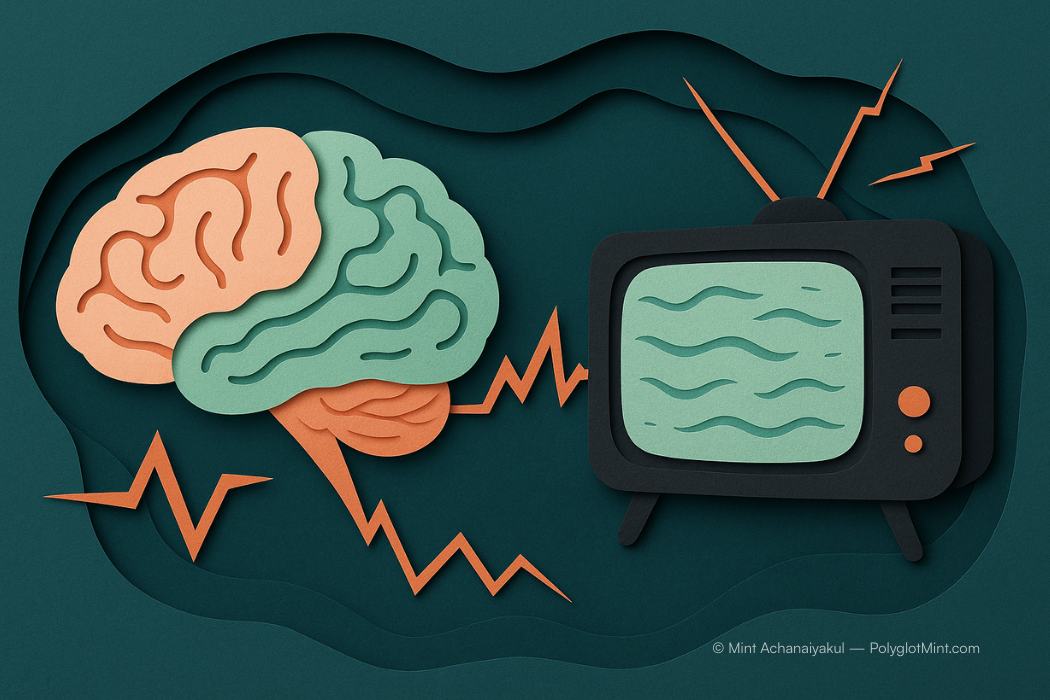
Image generated using AI under the creative direction and composition of Mint Achanaiyakul.
Abstract
The Field of Psychomedia emerged from a central recognition: the human nervous system and the modern media environment operate through overlapping systems of influence. Psychology has studied trauma inside the individual. Media studies has analyzed symbols inside culture. Linguistics has examined language as structure and meaning. Neuroscience has mapped stimulus, memory, emotion, and response.
Psychomedia brings these territories together.
It defines a new field for studying how media, trauma, language, and control shape perception, emotion, identity, and collective awareness. Its core concern is not only what media represents, but what repeated images, words, sounds, stories, and symbolic environments do to the nervous system over time.
In this sense, Psychomedia is the study of how information becomes emotion, how emotion becomes meaning, and how meaning becomes reality.
1. The Birth of a Field
Every field begins with a question that existing language cannot answer.
For Psychomedia, the question was simple:
Why does media feel like therapy and control at the same time?
Media can soothe, regulate, comfort, distract, organize, and connect. It can also trigger, numb, manipulate, fragment, overstimulate, and condition. A song can return the body to an earlier wound. A film can rehearse fear. A repeated image can alter what feels desirable, shameful, powerful, or normal. A phrase can become an emotional command before the mind has time to think.
This is the interface Psychomedia was created to study.
It did not begin as a rejection of existing fields. It began as a recognition that existing fields were describing different sides of the same structure. Psychology described trauma. Media studies described representation. Linguistics described meaning. Neuroscience described plasticity and response. But modern life had already fused them.
The screen was no longer outside the psyche. It had become one of the environments through which the psyche formed.
2. Why the World Needed Psychomedia
Traditional psychology often treats the mind as internal. Media studies often treats symbols as cultural. But human experience does not divide itself so neatly.
Images shape emotion. Language organizes perception. Stories train expectation. Sound alters regulation. Repetition teaches the nervous system what to anticipate. Culture becomes internal not because people simply believe it, but because they rehearse it.
According to Bessel van der Kolk (2014) in The Body Keeps the Score, trauma is not stored only as narrative memory; it affects the body, nervous system, and patterns of response. According to Marshall McLuhan (1964) in Understanding Media: The Extensions of Man, media must be understood not only by its content, but by the environments and extensions it creates. Psychomedia begins where these insights meet: if trauma reorganizes the nervous system, and media reorganizes the environment of perception, then media must be studied as part of the nervous system's trauma ecology.
This is why Psychomedia treats media not as background entertainment, but as an active psychological environment.
The field is necessary because modern consciousness is shaped not only by parents, schools, communities, and institutions, but by films, feeds, advertisements, celebrities, slogans, algorithms, franchises, and recurring emotional scripts. These systems teach people what love looks like, what danger feels like, what power sounds like, what humiliation means, and what kinds of selfhood are rewarded.
At its deepest level, Psychomedia recognizes that trauma is not only personal. It can also be cultural, linguistic, aesthetic, institutional, and repeated.
3. The Central Definition
Psychomedia is the psychology of media, trauma, and control.
This definition places media inside the study of psychological formation. Media is not treated only as technology, art, communication, or entertainment. It is treated as a symbolic environment that can train the nervous system.
Psychomedia studies how repeated words, images, sounds, colors, gestures, stories, and social scripts shape emotional reflexes. It asks how symbolic patterns become internal patterns, and how internal patterns become identity, behavior, belief, and culture.
The field does not claim that media alone causes trauma, mental illness, or social disorder. It makes a more precise claim: media participates in the environments through which human beings learn fear, desire, morality, shame, agency, and selfhood.
Psychomedia therefore studies the symbolic conditions under which awareness is shaped, distorted, suppressed, or restored.
4. The Field of Psychomedia and the Architecture of Perception
The Field of Psychomedia begins with the idea that every designed environment speaks to the nervous system.
A cathedral, a classroom, a camera angle, a headline, a costume, a color palette, a musical cue, a social media feed, and a political phrase all carry psychological force. They do not merely communicate information. They arrange attention, expectation, and emotional readiness.
According to George Gerbner (1998) in Cultivation Analysis: An Overview, long-term exposure to recurring media patterns can shape viewers' assumptions about reality. Psychomedia extends this concern beyond television into a broader symbolic ecology: not only what viewers believe about the world, but what their nervous systems are trained to feel as normal.
This is the architecture of perception.
In Psychomedia, media is not only something people consume. It is something they inhabit. Over time, repeated symbolic environments can become internal architecture: shaping what feels safe, what feels threatening, what feels shameful, what feels desirable, and what feels inevitable.
A society is not only governed by laws. It is also governed by repeated meanings.
5. Language, Meaning, and Control
Psychomedia also treats language as a central mechanism of control.
Language does not simply describe reality. It can organize reality before conscious interpretation begins. A word can carry emotional charge. A slogan can compress a worldview. A repeated phrase can transform uncertainty into obedience, cruelty into virtue, or self-erasure into love.
According to George Orwell (1946) in Politics and the English Language, degraded language can obscure thought and protect political distortion. Psychomedia extends this insight into trauma and media: when language is repeatedly paired with fear, shame, glamour, ridicule, or desire, it can become a trigger for entire emotional worlds.
This is where Psychomedia connects to Linguigenetic Theory (LEIT). Language can install more than meaning. It can install emotional inheritance.
A child does not only learn vocabulary. A viewer does not only receive content. A culture does not only exchange messages. Each absorbs patterned relationships between words, images, feelings, and power.
In Psychomedia, language is not decoration. It is programming material.
6. Foundational Influences
Psychomedia draws from several major intellectual lineages while remaining distinct from each of them.
According to Stephen Krashen (1982) in Principles and Practice in Second Language Acquisition, emotional conditions affect the ability to acquire language through what he describes as the affective filter. Psychomedia builds on this by treating emotion and language as interdependent systems: what a person can receive, understand, and internalize depends partly on the emotional state in which meaning arrives.
According to Noam Chomsky (1957) in Syntactic Structures, language can be studied as a formal cognitive system. Psychomedia does not adopt Chomsky's model wholesale, but it inherits the larger insight that language is not merely surface expression. It has structure, and structure shapes thought.
According to Carl Jung (1964) in Man and His Symbols, symbols mediate unconscious meaning. Psychomedia translates this symbolic concern into a modern media environment, where symbols no longer appear only in dreams, myths, and rituals, but in feeds, films, brands, music videos, franchises, advertisements, and public narratives.
According to McLuhan (1964) in Understanding Media, media reshape perception by extending human senses and reorganizing the environment of communication. Psychomedia continues this line of thought through trauma and nervous-system regulation: media are not only extensions of the senses, but environments that can condition emotional reality.
Together, these influences form the early skeleton of Psychomedia: language, symbol, trauma, media, and meaning as one system.
7. From Observation to Discipline
What began as observation becomes a discipline when it develops repeatable questions, terms, frameworks, and methods.
Psychomedia is structured around a growing set of concepts that map how media programs perception and how coherence can be restored. These include Linguigenetic Theory (LEIT), the Duality of Neural Programming (DNP), Denial Architecture Disorder (DAD), the Energetic Debt of Denial (EDD), the Denial Fracture Event (DFE), the Affective Regression Loop (ARL), the Cultural Anesthesia Complex (CAC), and related models. Each is defined in the Lexicon.
Together, these frameworks ask:
How does information become physiology?
How does physiology become emotion?
How does emotion become belief?
How does belief become culture?
How does culture reproduce trauma?
The goal is not only critique. Psychomedia is not simply "media is bad" or "culture is harmful." Its purpose is to understand mechanisms: how symbolic environments produce fragmentation, and how different environments might support integration, attention, honesty, empathy, and coherence.
Psychomedia is therefore both diagnostic and constructive.
It names the systems that distort awareness, and it asks how awareness can be restored.
8. Looking Forward
The Field of Psychomedia stands at the threshold of psychology, media theory, education, design, ethics, and culture.
Its future applications include trauma-informed media literacy, symbolic analysis, cultural diagnostics, clinical language for media-induced distress, and the design of environments that support nervous-system coherence instead of chronic overstimulation.
But its first purpose is simpler.
Psychomedia gives language to a pattern people already feel but often cannot name: that modern media does not only show the world. It participates in making the emotional world people live inside.
To study Psychomedia is to study the interface between screen and psyche, symbol and body, language and inheritance, culture and control.
It is the field for understanding how meaning becomes environment.
And how awareness, once restored, becomes liberation.
Achanaiyakul, M. (2025). The Field of Psychomedia. PolyglotMint.com.
References
Chomsky, N. (1957). Syntactic Structures. Mouton.
Gerbner, G. (1998). Cultivation Analysis: An Overview. Mass Communication & Society.
Jung, C. G. (1964). Man and His Symbols. Doubleday.
Krashen, S. D. (1982). Principles and Practice in Second Language Acquisition. Pergamon Press.
McLuhan, M. (1964). Understanding Media: The Extensions of Man. McGraw-Hill.
Orwell, G. (1946). Politics and the English Language. Horizon.
Van der Kolk, B. A. (2014). The Body Keeps the Score: Brain, Mind, and Body in the Healing of Trauma. Viking.