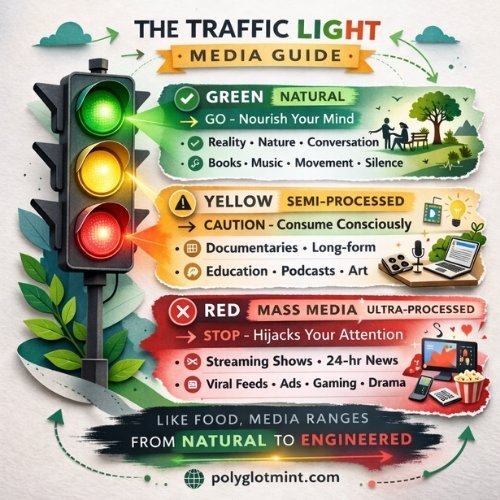
Image generated using AI under the creative direction and composition of Mint Achanaiyakul.
In How Not to Die , Dr. Michael Greger introduces a Traffic Light system for ranking foods as green, yellow, or red. According to Greger (2015), the goal is practical self-regulation, not moral panic. He later summarizes the same system in Dining by Traffic Light: Green Is for Go, Red Is for Stop as a quick-reference version readers can use immediately.
This guide applies the same logic to perception. If food shapes metabolic health, repeated sensory input shapes mental health. You are what you eat, and you are what you rehearse with your eyes and ears. The Traffic Light Media Guide is not only attention hygiene. It is mind hygiene: what you feed your nervous system through sight and sound, and how that diet shapes attention, mood, empathy, sleep, and self-control.
Abstract
The Traffic Light Media Guide is a practical model for mind hygiene. It classifies media the way nutrition science classifies food: from minimally altered inputs to engineered, dependency-oriented products. The aim is not "screen purity." It is restoring state control in a world optimized for compulsion.
From nutritional processing to neural processing
Nutrition researchers use "ultra-processed" to describe industrial formulations designed for convenience and hyper-palatability rather than recognizable foods. According to Monteiro (2019) in Ultra-processed foods: what they are and how to identify them, the defining feature is the industrial design of the product, not simply "calories."
That design changes behavior in measurable ways. According to Hall (2019) in Ultra-processed diets cause excess calorie intake and weight gain, participants consumed more energy and gained weight on an ultra-processed diet in an inpatient randomized trial, even when meals were presented as matched across multiple nutrition variables.
Media has an equivalent spectrum. Some inputs are reality in real time. Some are edited but still metabolizable. Some are engineered to keep you consuming: cue saturation, cliffhangers, jump cuts, outrage spikes, and endless novelty disguised as "content."
The nervous system learns through prediction and reward signals, not through "truth." According to Schultz (1997) in A Neural Substrate of Prediction and Reward, dopaminergic activity tracks shifts in expectation about salient outcomes, meaning cues can become powerful drivers of attention and behavior.
This is why red media can feel irresistible even when it doesn't feel good. Cue-driven wanting can detach from actual pleasure. According to Berridge (2016) in Liking, wanting, and the incentive-sensitization theory of addiction, incentive salience can amplify motivation and cue-reactivity without increasing liking. Mind hygiene is partly about keeping cue-reactivity from becoming your default state.
Red-heavy media diets tend to produce the same predictable pattern:
- Shorter attention span and stronger cue-reactivity.
- More irritability and anxiety from constant micro-arousal.
- Lower empathy and patience (faster judgment, less context-holding).
- Worse sleep quality from late-day stimulation and mental 'carryover.'
- Harder self-control because regulation gets outcompeted by intensity.
According to Greger (2016) in HOW NOT TO DIE: The Role of Diet in Preventing, Arresting, & Reversing Our Top 15 Killers, the body can heal under the right conditions, but not if we keep "whacking it in the same place" three times a day. Mind hygiene works the same way: if you keep dosing your nervous system with red inputs at breakfast, lunch, and dinner, the system never gets a real recovery window.
Neural "stabilizers" (metaphor, but useful)
High-intensity stimulation is not automatically "bad." The problem is chronic imbalance: too much cue-driven arousal with too little safety, delay tolerance, inhibition, and sleep-based repair. If red media trains speed and intensity, mind hygiene has to rebuild the stabilizers red crowds out.
Oxytocin (trust and safety cues). According to Kosfeld (2005) in Oxytocin increases trust in humans, oxytocin administration increased trust behavior in an experimental context. The point here is not "oxytocin fixes you." It is that the nervous system is designed to regulate through felt safety and relational cues, not endless novelty.
Serotonin (waiting and delay tolerance). According to Miyazaki (2012) in Activation of dorsal raphe serotonin neurons is necessary for waiting for delayed rewards, serotonergic activity supports waiting for delayed rewards. Red media repeatedly trains the opposite: instant resolution, instant novelty, instant payoff.
Sleep (repair and reset). According to Xie (2013) in Sleep Drives Metabolite Clearance from the Adult Brain, sleep is associated with increased clearance of metabolic waste products in a mouse model, one mechanistic account for why sleep restores cognition. Red media is uniquely effective at colonizing the exact window that protects mind hygiene most: the pre-sleep hours.
The Traffic Light Media Guide is a way to stop living in the red-zone long enough for these stabilizers to do their job.
The Traffic Light Media Guide framework
Green— Natural stimulation
Grounded, reality-based inputs that restore coherence.
ExamplesNature, face-to-face conversation, physical books, movement, silence, acoustic music.
Yellow— Managed stimulation
Useful inputs that require limits and conscious regulation.
ExamplesSocial media, streaming, news, productivity apps, online learning.
Red— Harmful stimulation
Inputs that destabilize attention, self-worth, sleep, empathy, or control.
ExamplesInfinite-scroll feeds, viral outrage loops, doomscrolling, autoplay binge content.
Green — Natural stimulation
Green input restores coherence because it is not built from micro-cues. It does not force your nervous system to sprint. It returns attention to baseline, where meaning can land and self-control can exist.
Even green can become psychologically corrosive when it encodes humiliation, domination, mockery, or fear as the price of belonging. The medium may be green. The language can still be toxic. In Psychomedia terms, that is the Language of Abuse (LoA): communication patterns that train shame, submission, or conditional worth.
Grown in reality, not manufactured in pixels.
Yellow — Managed stimulation
Yellow inputs are useful but engineered to hold attention, so they stay healthy only with limits: social media, streaming, news, productivity apps, and online learning. Each can connect, inform, or build real skills — and each can quietly tip into compulsion when it runs unbounded.
Yellow media earns its place through conscious regulation: decide when it starts and stops, and watch the aftertaste. A practical test: after you finish, do you feel more capable of real life, or less? More integrated, or more agitated? Anything that consistently fails that test is drifting toward red.
Consume consciously, not compulsively.
Red — Harmful stimulation
Red media is engineered around cue density and reinforcement schedules: cliffhangers, auto-play, notifications, outrage spikes, and identity-triggered validation. It trains compulsive state access: attention pulled by cues, emotion pulled by intensity, and meaning replaced by stimulation.
When saturated with LoA—mockery, manipulation, fear, conditional validation—it becomes neurologically corrosive. Anxiety, irritability, dysphoria, attention decay, and reduced capacity for calm bonding stop being mysterious "mental health issues" and start looking like predictable outputs of a red-heavy perceptual diet.
Neural junk food, flavored with trauma.
Even negativity can become addictive. The nervous system can treat intensity as reward, which makes gossip, outrage, fear-scrolling, and humiliation-based entertainment feel compelling even when it leaves you worse. Red media exploits that distortion by pairing harm with reinforcement until dysregulation becomes a habit.
How to use the guide without going off-grid
Default to green first. If your day has no green, yellow won't stabilize you and red will dominate.
Schedule yellow like a meal. Start and end on purpose. Don't graze.
Quarantine red. If you choose it, time-box it. Avoid it as the first input of the day and the last input before sleep.
Track the aftertaste. Don't ask only "Did I enjoy it?" Ask: Did it improve my attention? My mood? My patience? My sleep? My ability to connect?
Mind hygiene is not about purity. It is about agency. Greger's model taught people to eat from the earth. The Traffic Light Media Guide teaches you to see with discernment. Choose inputs that feed you, not inputs that feed on you.
Notes on novelty
This guide extends a nutrition-style processing model into a perception model: mind hygiene is treated as a biological resource with inputs that range from minimally altered to industrially engineered. It turns "media literacy" from an abstract virtue into a daily decision system.
Mint Achanaiyakul, 2026. The Traffic Light Media Guide. (PolyglotMint)
References
Berridge (2016). Liking, wanting, and the incentive-sensitization theory of addiction. (American Psychologist)
Greger (2015). How Not to Die: Discover the Foods Scientifically Proven to Prevent and Reverse Disease. (Flatiron Books)
Greger (2016). HOW NOT TO DIE: The Role of Diet in Preventing, Arresting, & Reversing Our Top 15 Killers. (NutritionFacts.org)
Greger, 2021 (updated 2023). Dining by Traffic Light: Green Is for Go, Red Is for Stop. (NutritionFacts.org)
Hall (2019). Ultra-processed diets cause excess calorie intake and weight gain: An inpatient randomized controlled trial. (Cell Metabolism)
Kosfeld (2005). Oxytocin increases trust in humans. (Nature)
Miyazaki (2012). Activation of dorsal raphe serotonin neurons is necessary for waiting for delayed rewards. (Journal of Neuroscience)
Monteiro (2019). Ultra-processed foods: what they are and how to identify them. (Public Health Nutrition)
Schultz (1997). A Neural Substrate of Prediction and Reward. (Science)
Xie (2013). Sleep Drives Metabolite Clearance from the Adult Brain. (Science)