Psychomedia 101
START HERE
What Is Psychomedia?
A beginner guide to the psychology of media, trauma, and control.

Psychomedia is the psychology of media, trauma, and control.
It studies how media does more than inform, entertain, or distract. Media shapes what people notice, what they feel, what they remember, what they deny, and what they become.
Most people think of media as content: films, news, posts, images, music, feeds, advertisements, algorithms, stories. Psychomedia looks at media as an environment. It asks what happens when a person lives inside repeated symbolic input long enough for it to shape perception, emotion, identity, and nervous-system response.
Why Psychomedia Matters
Media is not neutral.
A person does not simply "watch" media and remain unchanged. The nervous system responds. Attention is pulled. Emotion is activated. Fear, desire, shame, urgency, longing, disgust, and belonging can be trained through repetition.
Over time, repeated media patterns can begin to feel like reality itself.
Psychomedia studies this process. It looks at how symbolic environments influence the inner world: not only what people believe, but what they are able to feel, remember, imagine, or question.
Media as Psychological Environment
A psychological environment is anything that repeatedly shapes how a person experiences the world.
Family can be a psychological environment. School can be a psychological environment. Religion, language, politics, advertising, entertainment, and social media can also become psychological environments.
Psychomedia focuses on the symbolic layer of that environment.
It asks questions like:
- How does media teach people what is normal?
- How does repetition make certain emotions feel natural?
- How do stories train desire, fear, shame, or denial?
- How do images shape the body's sense of safety or threat?
- How do platforms reward some states of mind and punish others?
When media becomes environment, it does not only deliver information. It trains the conditions under which the mind interprets reality.
Trauma, Language, and Control
Psychomedia is especially concerned with trauma because trauma changes how the mind processes meaning.
A traumatized nervous system may scan for danger, avoid certain memories, shut down feeling, cling to familiar patterns, or repeat painful states that feel impossible to leave. Media can interact with those patterns.
It can soothe them. It can exploit them. It can normalize them. It can deepen them.
Language matters because language gives trauma a structure. Words can reveal experience, but they can also hide it. A culture can use language to name pain clearly, or to make pain disappear.
Control matters because media systems can shape what people are allowed to perceive. Control does not always look like force. Sometimes it looks like distraction, repetition, emotional exhaustion, spectacle, false urgency, or the constant replacement of reflection with reaction.
Psychomedia studies how these forces work together.
What Psychomedia Studies
Psychomedia studies the relationship between symbolic input and psychological state.
That includes:
- media and nervous-system response
- trauma and emotional repetition
- language and identity formation
- images and memory
- algorithms and attention
- culture and denial
- entertainment and dissociation
- symbolic systems and social control
It does not replace psychology, neuroscience, media studies, linguistics, or trauma theory. It connects them through one central question:
What happens to the mind when media becomes part of the environment that forms it?
Psychomedia Is a Field, Not Just a Topic
Psychomedia is not just "media affects people."
It is a field for studying how media systems interact with the mind over time.
A single movie, post, song, or image may matter. But Psychomedia is most interested in patterns: repeated exposure, repeated emotional states, repeated language, repeated symbols, and repeated cultural instructions.
It looks at how those patterns become internal.
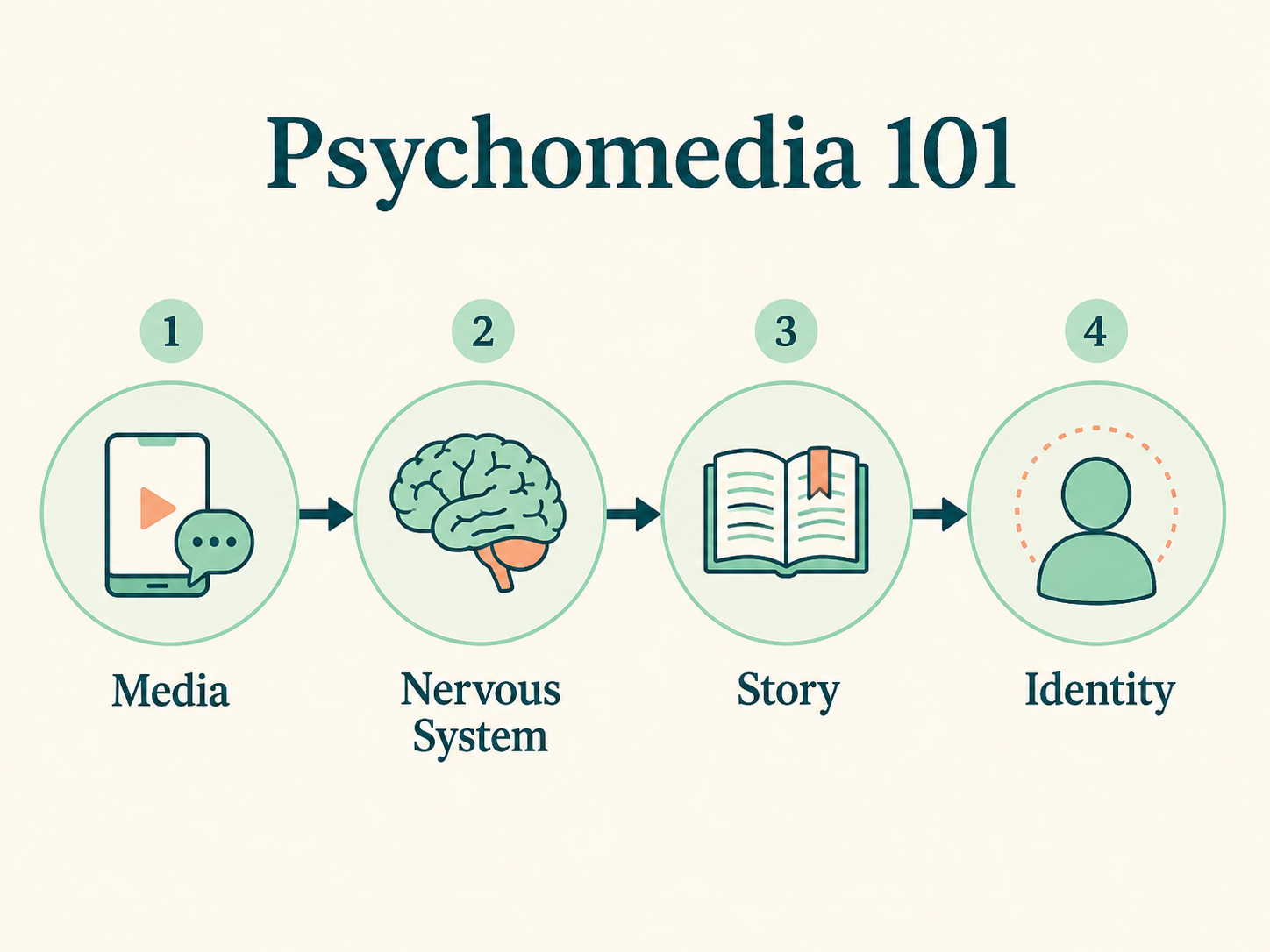
The simplest way to understand it is this:
- Media enters the mind as stimulus.
- Repeated stimulus becomes state.
- Repeated state becomes story.
- Repeated story becomes identity.
Where Psychomedia Comes From
Psychomedia did not come from one discipline.
It drew on trauma theory, linguistics, media analysis, political critique, semiotics, and direct observation of how language, media, and trauma converge in lived experience.
Several thinkers shaped its foundations. George Orwell clarified how language can become a tool of control. Bessel van der Kolk showed how trauma reshapes the nervous system, perception, memory, and behavior. Stephen Krashen’s model of language acquisition showed how environment, safety, and repeated exposure shape what the mind absorbs. Michael Greger’s inheritance logic helped frame how patterns can pass through generations not only through genes, but through conditions, behaviors, and repeated environments.
Media theory, propaganda analysis, and symbolism added another layer: the study of how images, stories, repetition, spectacle, and cultural signals train perception.
But Psychomedia is not simply a combination of these influences. It is a framework built from seeing the same pattern across fields that usually remain separate.
Put simply:
Orwell, van der Kolk, Krashen, and Greger gave fragments. Psychomedia built the framework.
Key Terms
Where to Go Next
This article is the beginner entry point.
For the full foundational version, read Psychomedia: The Psychology of Media, Trauma, and Control.
For the field-level explanation, read The Field of Psychomedia.
For the system map, read The Psychomedia Framework.
Together, these articles explain the central idea: media is not only something people consume. It is one of the environments through which modern consciousness is shaped.
References
Achanaiyakul, M. (2026). Psychomedia: The Psychology of Media, Trauma, and Control. (PolyglotMint)
Achanaiyakul, M. (2026). The Field of Psychomedia. (PolyglotMint)
Achanaiyakul, M. (2026). The Psychomedia Framework. (PolyglotMint)
Originally published at PolyglotMint.