Discovery of Sex–Death Outputs as a Moral Pattern
Why compulsion produces predictable moral signatures
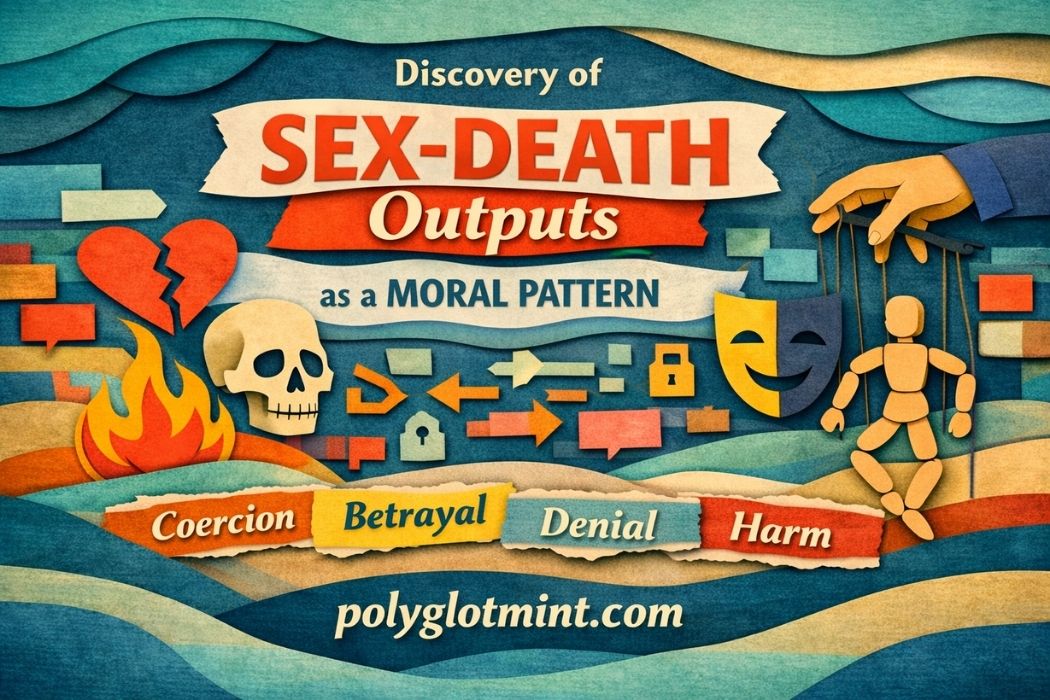
Image generated using AI under the creative direction and composition of Mint Achanaiyakul.
Abstract
This Discoveries record documents a specific inference inside The Duality of Neural Programming (DNP): if Sex–Death is a recognizable compulsive state orientation, it should not only feel distinctive. It should also produce repeatable outputs. The claim here is that Sex–Death outputs cluster into a coherent moral pattern because state access constrains conscience-access, context-holding, inhibition, and the brain’s ability to switch out of reward-locked pursuit. This paper defines “loop” operationally, proposes observable output clusters, and ties them to testable correlates in attention, control, network switching, and sleep disruption.
Why Discovery of Sex–Death Outputs as a Moral Pattern Was Necessary
Moral behavior is commonly treated as identity: “good person” or “bad person,” “strong values” or “weak values.” But if DNP is correct, many moral shifts are better explained as state shifts. Under compulsion, people do not merely choose differently. They perceive differently, prioritize differently, rationalize differently, and bond differently. The same person can appear to “become someone else” because a different state is running the system.
Provenance note: Remembering my own manic-state extremes made the loop structure easier to recognize as state-dependent rather than trait-based. Later, those extremes also made it easier to see why vice-language often describes a predictable output pattern rather than a stable identity claim.
Definitions: Output and Loop
A Sex–Death “output” is a repeatable pattern in behavior, language, meaning-making, and bonding style that emerges when compulsive salience dominates attention and decision-making. An output is not a single act. It is a signature.
A loop is the engine that keeps those signatures stable. Loop is defined here as a self-reinforcing state cycle in which a cue triggers compulsion, attention locks onto a target, behavior repeats to obtain relief or reward, and repetition strengthens future state access while resisting switching.
If the loop is the engine, moral pattern is the exhaust. The moral pattern is what the loop reliably produces when it is active.
The Moral Signature of Sex–Death Outputs
Sex–Death outputs tend to cluster into a small set of recognizable signatures. These signatures are not meant to be moralistic. They are meant to be measurable and falsifiable.
Conscience displacement
When Sex–Death is active, conscience-access weakens. The mind becomes more willing to treat urgency as permission. Rationalization increases because the loop demands continuity. The person does not merely want the target. The person needs the loop to remain intact.
This is one reason “I had to” language becomes common. The output is not only behavior. The output is a template of justification that protects the loop from interruption.
Context collapse
A defining feature of compulsion is a narrowed time horizon. The loop makes the present feel ultimate. Long-term consequences, commitments, and relational reality become harder to hold simultaneously.
In practical terms, this is how betrayal becomes plausible without fully “feeling” like betrayal. The mind is not holding the whole context. It is holding the cue and the relief.
Truth degradation
Sex–Death outputs often degrade truth because truth threatens the loop. The degradation can range from omission to compartmentalization to outright deception. It can also appear as denial of harm, denial of patterns, or denial of consequence.
This is not always strategic lying. Often it is cognitive self-protection. A loop cannot survive full reality contact if reality contact would force switching.
Instrumental bonding
Sex–Death can imitate bonding through pursuit, intensity, reward, novelty, secrecy, and conquest. But it treats persons as instruments of relief rather than whole beings with claims. That shift is legible as objectification, extraction, and entitlement.
When this output is active, people can be “loved” and used in the same breath because the operative bond is not mutuality. It is compulsion.
Harm-threshold shift
Under Sex–Death, the threshold for harm shifts. Self-harm becomes more plausible. Other-harm becomes easier to justify. Cruelty can become a byproduct of urgency, and contempt can become a stabilizer that keeps the loop running by devaluing the person harmed.
This is the moral core of the claim: Sex–Death is not merely an appetite. It is a state that reliably changes what harm feels permissible.
Mechanistic Correlates and Testable Proxies
The goal here is not to reduce morality to EEG bands or a single brain region. The goal is operational clarity: if outputs are state-dependent, then there should be correlates in gating, inhibition, and switching.
According to Klimesch (2012) in α-band oscillations, attention, and controlled access to stored information, alpha-band activity is closely tied to inhibitory function and controlled access in information processing. In DNP terms, Love–Life requires stronger access-control and restraint capacity, while Sex–Death is more likely to “break through” gates because the loop treats the target as urgent.
According to Engel and Fries (2010) in Beta-band oscillations—signalling the status quo, beta-band activity is associated with maintaining the current sensorimotor or cognitive state. This aligns with the felt “stickiness” of loops: persistence, set-maintenance, and resistance to switching even when switching would be healthier.
At the systems level, the core question is switching. According to Menon (2011) in Large-scale brain networks and psychopathology: a unifying triple network model, dysfunction in engaging and disengaging major brain networks is relevant across multiple disorders. DNP fits this framing as a state-access model: whichever mode is “in control” determines what feels urgent, what it means, and what behavior repeats. The moral pattern emerges because switching failure prolongs the loop and prolongs the output signatures that protect the loop.
Moral decision-making specifically also shows a conflict between control processes and emotional salience. According to Greene and colleagues (2004) in The neural bases of cognitive conflict and control in moral judgment, moral judgment involves cognitive conflict and control processes that can compete with more automatic responses. This supports the operational idea that reduced control access under compulsion can produce predictable shifts in moral output.
Sleep disruption matters because it degrades self-regulation and raises loop intensity. According to Barnes and colleagues (2011) in Lack of sleep and unethical conduct, lower sleep is associated with increased unethical behavior and reduced self-control resources. In DNP terms, sleep loss lowers switching capacity and increases the probability that Sex–Death outputs will appear and persist under trigger exposure.
Output Clusters
To make the claim testable, Sex–Death outputs can be grouped into observable clusters. These are meant as measurement targets, not moral labels.
Extraction outputs: Taking without mutuality. Entitlement. Treating persons as reward objects.
Coercion outputs: Pressure, boundary testing, escalation, manipulation, punishment logic when resisted.
Betrayal outputs: Double-life behavior, secrecy, selective honesty, “compartmentalized conscience.”
Cruelty outputs: Contempt stabilization, humiliation, dominance pleasure, dehumanizing language.
Denial outputs: Minimization, reality distortion, blame shifting, moral inversion that protects the loop.
Self-abandonment outputs: Self-harmful choices framed as “need,” “freedom,” or “truth,” when they are better explained as loop maintenance.
These clusters are intentionally simple. They allow coding, rating, and measurement across time as state fluctuates.
Predictions
If this model is correct, several predictions follow.
Switching latency should predict moral recovery speed. People who can disengage and reorient faster should show shorter durations of denial, coercion, and betrayal outputs after trigger exposure.
Sleep disruption should predict output intensity. Reduced sleep should increase loop persistence and raise the probability of extraction and truth-degradation outputs under stress. According to Barnes and colleagues (2011), sleep loss is associated with increased unethical behavior, consistent with this direction of effect.
Inhibitory-control strength should predict restraint under salience. Stronger access-control should correlate with lower escalation, lower rationalization density, and greater capacity for silence, delay, and boredom without output collapse. According to Klimesch (2012), inhibitory gating is a plausible mechanism for this difference.
State transitions should be visible in language. As compulsion rises, urgency language, self-exemption templates, and contempt framing should rise, then fall as Love–Life access returns.
Integration With the Neuro-Moral Spectrum
This discovery is a bridge. DNP identifies state polarity. NMS maps moral orientation. Sex–Death outputs explain why vice traits cluster: they are not random moral flaws. They are state-expressive signatures produced by loops. Love–Life outputs are not merely “good behavior.” They are the behavioral availability of coherence.
This is why NMS can treat vice and virtue as state-linked rather than ideology-linked. The moral vocabulary is describing outputs of orientation.
The Biblical Frame as Confirmation Language
The theological frame is not used here as scientific evidence. It functions as confirmation language that has historically named a similar polarity in human experience.
According to KJV in Galatians 5:17, there is an inner conflict between flesh and Spirit. In operational terms, repetition strengthens what it practices. Loops strengthen compulsion. Repeated coherent patterns strengthen access to coherence.
This is also why the Fruits of the Spirit can be treated as an output profile rather than a personality claim. According to KJV in Galatians 5:22–23, the fruit of the Spirit includes love, joy, peace, longsuffering, gentleness, goodness, faith, meekness, and temperance. In DNP terms, Love–Life access makes that output set more behaviorally available by restoring context-holding, restraint, and conscience-access.
Notes on Novelty
This paper does not claim a new virtue theory. It claims that Sex–Death outputs form a measurable moral signature because compulsion is a state with predictable constraints on attention, inhibition, and switching.
The novelty is intentionally narrow. Sex–Death is presented as a loop-driven output generator with identifiable clusters and testable correlates. The contribution is an operational synthesis: moral pattern can be modeled as state-dependent output, not only as trait, ideology, or moral education.
This yields straightforward research targets: switching latency, loop persistence, sleep-mediated control loss, and language-based output tracking across state transitions.
Mint Achanaiyakul, 2026. Discovery of Sex–Death Outputs as a Moral Pattern. (Discoveries, PolyglotMint)
References
Barnes and colleagues 2011. Lack of sleep and unethical conduct. (Organizational Behavior and Human Decision Processes)
Engel and Fries 2010. Beta-band oscillations—signalling the status quo. (Current Opinion in Neurobiology)
Greene and colleagues 2004. The neural bases of cognitive conflict and control in moral judgment. (Neuron)
King James Bible 1611. Galatians 5:17. (BibleGateway)
King James Bible 1611. Galatians 5:22–23. (BibleGateway)
Klimesch 2012. α-band oscillations, attention, and controlled access to stored information. (Trends in Cognitive Sciences)
Menon 2011. Large-scale brain networks and psychopathology: a unifying triple network model. (Trends in Cognitive Sciences)