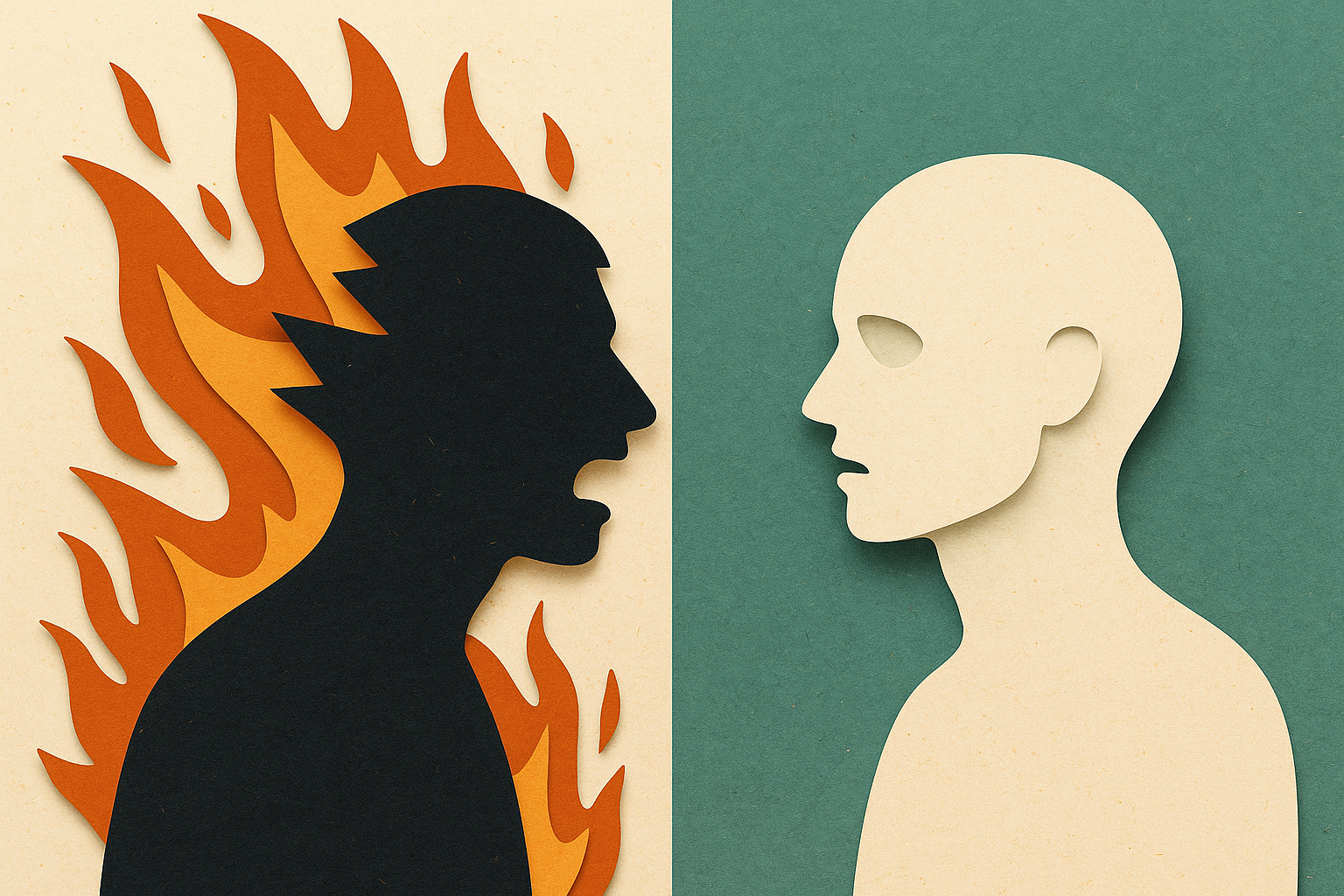
Blank Imagery During Visualization
Why “I see nothing” can be self-protection
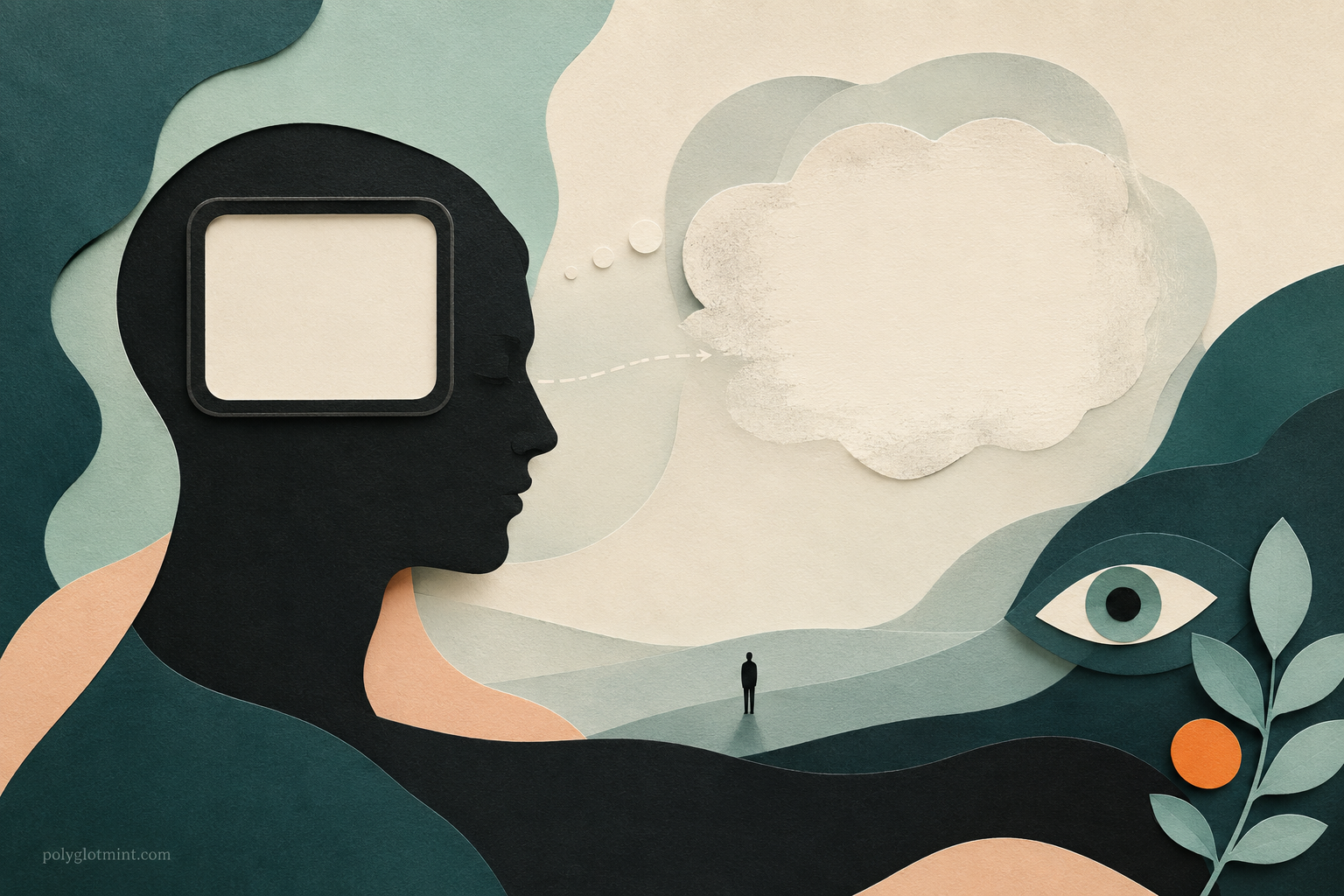
Image generated using AI under the creative direction and composition of Mint Achanaiyakul.
Abstract
Many trauma survivors report "seeing nothing" during visualization therapy, EMDR imagery prompts, body-based exercises, Rorschach testing, or other projective tasks. This blankness is sometimes interpreted as lack of imagination, resistance, detachment, or unwillingness to engage.
This paper proposes a different model.
Blank imagery during visualization may not be absence. It may be protection. When the nervous system predicts that inner imagery would bring traumatic material too close to conscious access, perception may shut down before the image forms. The result is not a failure of imagination, but a protective reduction of access.
In this model, the mind does not show "nothing" because nothing is there. It shows nothing because something may be too destabilizing to see.
Clinical Boundary
1. The Misinterpretation of "Nothing"
When a client is asked to visualize a memory, scene, body sensation, or inkblot and says, "I don't see anything," the response can be misread.
Some clinicians may hear disengagement. Others may hear resistance. In social settings, the person may even be told they are not imaginative, not trying, or too detached from feeling.
But "nothing" is not always empty.
Sometimes nothing is a locked door.
A person may know that something should be there, but cannot access it. They may feel a pressure around the blankness, as if the image exists behind a wall. They may be able to visualize neutral scenes, fantasies, characters, designs, or everyday memories, but lose imagery specifically when the prompt approaches traumatic material.
That distinction matters.
If blankness appears only near emotionally loaded material, it may not be a general imagination problem. It may be a safety response.
2. Blank Imagery During Visualization as Protection
Psychic anesthesia
Protective numbing of awareness — feeling and imagery are muted to shield the system from what it cannot yet safely process.
Blank imagery during visualization can be understood as the nervous system choosing regulation over access.
Visualization is often treated as a mental act, but it is also a bodily event. To visualize a memory or scene, the person may have to approach sensory, emotional, and autobiographical material. If that material is linked to trauma, the body may evaluate the prompt as threat.
According to Bessel van der Kolk (2014) in The Body Keeps the Score, trauma affects the body, brain, and nervous system, shaping patterns of memory, activation, and response. In this context, blocked imagery can be understood as part of the body's attempt to prevent destabilizing access.
According to Ruth Lanius (2015) in Trauma-related Dissociation and Altered States of Consciousness, trauma-related dissociation can involve altered states across time, thought, body, and emotion. Blank imagery belongs near this territory: the person is not merely "not picturing." Consciousness itself may be narrowing what can safely appear.
In this model, imagery is not missing.
It is withheld.
Memory imagery is gated. Interoceptive access is dimmed. Emotional content is sealed behind shutdown. The mind reports "nothing" because "something" may exceed capacity.
The absence of imagery is not necessarily the absence of content. It may be the absence of permission.
3. Why the Brain Chooses Blankness Instead of Panic
Some trauma produces panic. Other trauma produces blankness.
Panic occurs when the nervous system allows emotional access, even if the experience is overwhelming. Blankness occurs when the nervous system predicts that access itself may be too dangerous.
In panic, the emotional signal becomes loud. In blankness, the emotional signal is reduced before it reaches awareness.
According to Allan Schore (2002) in Dysregulation of the Right Brain, traumatic attachment can involve hyperarousal and dissociation imprinted into developing limbic and autonomic systems. This supports the broader point that trauma response is not only what a person consciously feels, but how the nervous system regulates access to feeling.
Blankness may look calm from the outside, but it is not necessarily calm inside the system. It may be a silent emergency measure.
The body may be saying: Do not open this yet. Do not show this yet. Do not let the image form yet.
This is why pushing harder for imagery can backfire. If the blank field is a protective wall, pressure may strengthen the wall rather than dissolve it.
4. Aphantasia vs. Trauma-Gated Blankness
Aphantasia
Stable low or absent voluntary visual imagery — a baseline trait that is present across contexts, not triggered by specific material.
Trauma-gated blankness
A cue-dependent protective shutdown of inner imagery — the mind goes blank specifically when destabilizing material approaches awareness.
A key distinction is necessary.
Not all low imagery is trauma-based.
According to Zeman et al. (2015) in Lives Without Imagery — Congenital Aphantasia, aphantasia describes the inability to generate voluntary visual imagery. According to Keogh and Pearson (2018) in The Blind Mind: No Sensory Visual Imagery in Aphantasia, aphantasia involves a lack of sensory and phenomenal imagery, not merely poor metacognition.
That is different from trauma-gated blankness.
Aphantasia may be stable across many contexts. Trauma-gated blankness is often more selective. A person may be imaginative in ordinary life, creative work, dreams, fantasy, writing, design, or neutral visualization, but suddenly lose imagery when a prompt approaches traumatic memory, body sensation, shame, grief, fear, or attachment material.
The practical question is: Is the blankness global and stable? Or is it cue-dependent and threat-linked?
Blank imagery can also arise from anxiety, depression, medication effects, sleep deprivation, attentional overload, neurodivergence, or a mismatch between the prompt and the person's dominant imagery style. The claim here is not that all blank imagery is trauma.
The claim is narrower: when "I see nothing" appears specifically at the threshold of traumatic access, it may function as self-protection.
5. The Memory Firewall
A useful way to understand trauma-gated blankness is the image of a memory firewall.
A firewall does not mean there is no data. It means access is restricted.
When the mind blocks imagery, it may be preventing emotional material from loading into awareness before the body can safely regulate it. The person may feel blank, foggy, flat, or empty, but the blankness may be an active defense.
In Psychomedia language, this overlaps with psychic anesthesia: the protective numbing of awareness when feeling threatens coherence.
The blank field says: Not yet. That does not mean never. It means access has conditions.
6. Therapeutic Implications
When blank imagery is treated as protection, the therapeutic stance changes.
The goal is no longer to force the image to appear. The goal is to help the nervous system feel safe enough that imagery does not need to be blocked.
This changes the sequence of healing.
Safety comes before visualization. Regulation comes before memory access. Embodiment comes before interpretation. Capacity comes before image.
A client who sees nothing is not necessarily failing therapy. They may be succeeding at survival.
The therapeutic question becomes: What does the system need before seeing becomes safe?
Progress may begin very subtly: a color, a shape, a bodily sensation, a word, a temperature shift, a partial scene, or the ability to stay with the blankness without panic.
The return of imagery may not happen all at once. It may arrive as the nervous system learns that inner access no longer threatens collapse.
7. Notes on Novelty
Trauma literature has documented dissociation, shutdown, altered states of consciousness, and trauma-linked memory disruption. Research on aphantasia has also clarified that some people experience a stable absence of voluntary visual imagery.
This paper adds a specific Psychomedia reframing: blank imagery during visualization should not automatically be interpreted as lack of imagination, noncompliance, or detachment.
In some trauma-linked contexts, "I see nothing" may be a state-based protective response.
The model also creates a useful clinical prediction: when blank imagery is trauma-gated, increased safety and regulation capacity should lead to gradual return of access before full narrative or emotional recall becomes possible. That access may appear first as fragments, sensations, symbolic impressions, partial imagery, or emotional texture.
In other words: the image may return when the body believes seeing is survivable.
Conclusion
Blank imagery during visualization is not always an absence of imagination.
Sometimes it is a form of protection.
The mind may go blank not because there is nothing to see, but because seeing would bring the person too close to material the nervous system cannot yet hold. In that state, "I see nothing" is not failure. It is a boundary.
A trauma-informed approach does not tear down that boundary. It listens to it.
The goal is not to force the image open. The goal is to build enough safety that the image no longer has to hide.
Achanaiyakul, M. (2025). Blank Imagery During Visualization: Why "I See Nothing" Isn't a Lack of Imagination — It's Self-Protection. PolyglotMint.com.
References
Keogh, R., & Pearson, J. (2018). The Blind Mind: No Sensory Visual Imagery in Aphantasia. Cortex.
Lanius, R. A. (2015). Trauma-related Dissociation and Altered States of Consciousness: A Call for Clinical, Treatment, and Neuroscience Research. European Journal of Psychotraumatology.
Schore, A. N. (2002). Dysregulation of the Right Brain: A Fundamental Mechanism of Traumatic Attachment and the Psychopathogenesis of Posttraumatic Stress Disorder. Australian & New Zealand Journal of Psychiatry.
Van der Kolk, B. A. (2014). The Body Keeps the Score: Brain, Mind, and Body in the Healing of Trauma. Viking.
Zeman, A., Dewar, M., & Della Sala, S. (2015). Lives Without Imagery — Congenital Aphantasia. Cortex.