The Affective Regression Loop — How Trauma Becomes a Personality
How rewarded regression turns survival into identity
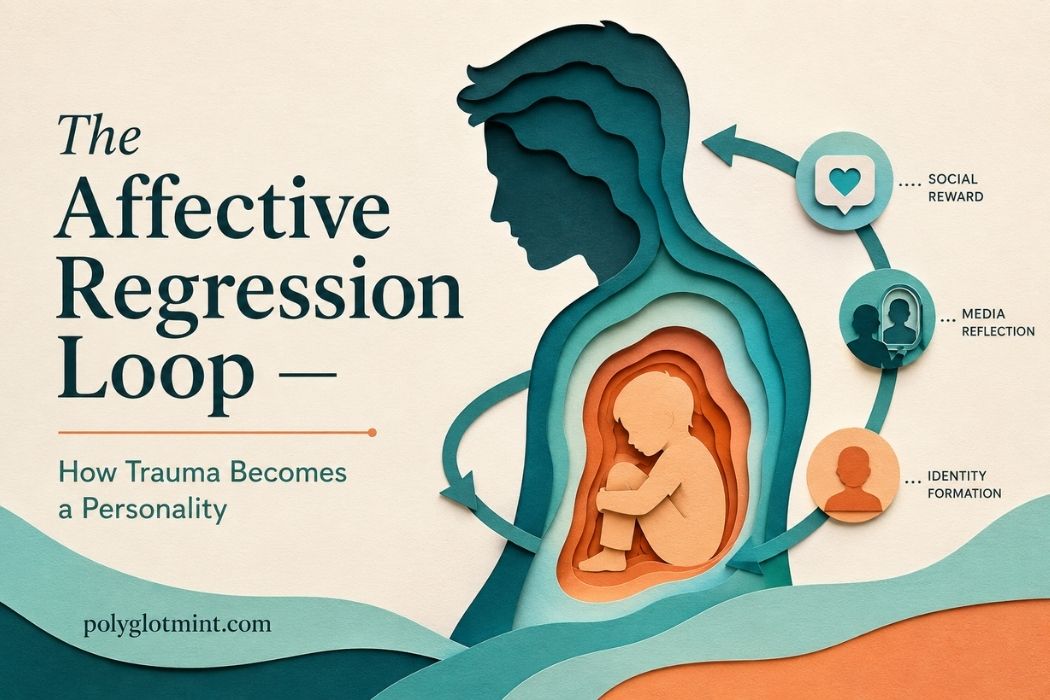
Image generated using AI under the creative direction and composition of Mint Achanaiyakul.
Abstract
This paper defines the Affective Regression Loop (ARL) as a Psychomedia mechanism through which trauma-based regression becomes reinforced, repeated, aestheticized, and eventually mistaken for personality.
ARL begins when the nervous system retreats into earlier emotional, linguistic, or relational patterns in response to threat. These patterns may include soft speech, helplessness, apology loops, exaggerated innocence, compliance, cuteness, dependency, or childlike affect.
The loop becomes culturally significant when these regressive behaviors are socially rewarded. Laughter, affection, sexual attention, caretaking, approval, and online visibility can teach the nervous system that regression produces safety. What began as protection may become performance. What becomes performance may become identity.
Drawing from trauma theory, affect regulation, reward learning, humor studies, obedience research, and social learning theory, this paper argues that trauma does not only repeat privately inside the individual. It can be reinforced socially and reflected aesthetically through media. ARL names the process by which unintegrated trauma becomes a rewarded style of being.
Introduction
Trauma does not always make a person appear hardened.
Sometimes it makes a person smaller.
The voice softens. The posture collapses. The person apologizes before being accused. Desire becomes compliance. Anger becomes sweetness. Fear becomes charm. The adult nervous system retreats into an earlier emotional grammar because that grammar once increased the chance of protection.
This retreat is what Psychomedia calls affective regression.
Affective regression is not simply "acting childish." It is the nervous system returning to an earlier emotional state when the present becomes too threatening to process from the adult self. The person may still be intelligent, capable, articulate, or socially functional, but their affect shifts toward helplessness, dependency, appeasement, cuteness, innocence, or submission.
The problem begins when this regression is rewarded.
If helplessness receives affection, if apology receives safety, if softness receives attention, if dependence receives approval, the brain begins to learn that regression works. The behavior does not remain a temporary defense. It becomes a loop.
That loop is the Affective Regression Loop (ARL).
The Affective Regression Loop explains how trauma becomes personality when regressive affect is repeatedly rewarded by others, imitated through culture, and internalized as identity.
What Is the Affective Regression Loop?
The Affective Regression Loop is the process through which trauma-based regression becomes reinforced into a stable pattern of self-presentation.
It has four movements:
- trauma produces regression;
- regression receives social reward;
- social reward teaches the nervous system that regression creates safety;
- the person repeats and internalizes the rewarded state.
Over time, the person may no longer experience the behavior as defensive. They may experience it as "just who I am." The loop transforms protection into personality.
According to Allan Schore (2019) in Right Brain Psychotherapy, early relational experience and affect regulation are deeply tied to right-brain emotional development. Psychomedia extends this logic into cultural reinforcement: if early affective states are later rewarded by social environments, the nervous system may continue returning to them as a strategy for safety.
According to Bessel van der Kolk (2014) in The Body Keeps the Score, trauma is carried not only as memory, but through the body, nervous system, and patterns of response. ARL applies this principle to personality formation: trauma may survive as tone, posture, charm, helplessness, apology, and relational performance.
The Affective Regression Loop is therefore not only psychological.
It is relational.
It is aesthetic.
It is cultural.
The Four Stages of the Affective Regression Loop
The Affective Regression Loop can be understood through four stages.
| Stage | Process | Result |
|---|---|---|
| 1. Emotional Regression | The nervous system retreats into earlier affective patterns associated with protection. | Safety through smallness, helplessness, softness, or submission. |
| 2. Social Reward | The regressive state receives laughter, affection, attention, caretaking, approval, or desire. | The behavior becomes associated with relief, belonging, or validation. |
| 3. Cultural Reflection | Media aestheticizes regression as cute, funny, innocent, romantic, desirable, or aspirational. | Regression becomes a recognizable style. |
| 4. Neural Re-Internalization | The person repeats and identifies with the rewarded behavior. | Trauma becomes personality. |
This is the core mechanism of ARL.
A person learns not only from what hurts, but from what receives reward after the hurt.
From Survival Response to Reward Pattern
In trauma, regression may function as a survival strategy.
The person returns to an earlier emotional mode because the adult self feels unsafe. This may happen in conflict, intimacy, performance, authority relationships, sexuality, family dynamics, or social evaluation. The nervous system searches for the state that once reduced danger.
If being small once protected the person, the body may become small again.
If apology once prevented punishment, apology becomes automatic.
If sweetness once reduced anger from others, sweetness becomes reflexive.
If helplessness once brought rescue, helplessness becomes relational language.
This does not mean the person is consciously manipulating others. In ARL, the behavior may begin involuntarily. The nervous system is not calculating. It is returning to an old map of survival.
But reward changes the pattern.
According to Wolfram Schultz, Peter Dayan, and P. Read Montague (1997) in "A Neural Substrate of Prediction and Reward," dopamine systems are deeply involved in learning from reward prediction. Psychomedia applies this to trauma-conditioned behavior: if regression repeatedly produces social reward, the nervous system may learn to predict safety through regression.
The person is not only avoiding danger.
They are learning which version of the self receives protection.
Affective Regression vs. the Fawn Response
The Affective Regression Loop overlaps with the fawn response, but it is not identical to it.
The fawn response is commonly used in trauma-recovery language to describe appeasement: pleasing, placating, agreeing, smoothing conflict, or suppressing the self to avoid danger. According to Pete Walker (2013) in Complex PTSD: From Surviving to Thriving, fawning can develop as a survival response in complex trauma, especially when the person learns that safety depends on pleasing others.
Fawning is behavioral.
Affective regression is affective and developmental.
Fawning negotiates danger.
Regression returns the nervous system to an earlier emotional state.
A person can fawn without becoming childlike. They can appease through competence, caretaking, perfectionism, sexuality, emotional labor, or agreement. Affective regression is more specific. It involves a shift in tone, posture, facial expression, language, helplessness, dependency, innocence, or soft self-presentation.
In simple terms:
Fawning says: "I will please you so I am safe."
Affective regression says: "I will become small so I am safe."
The Affective Regression Loop begins when that smallness is rewarded.
Humor, Cuteness, and the Social Reward of Regression
Regression becomes harder to see when it is entertaining.
A person who speaks softly, apologizes constantly, acts helpless, performs innocence, or collapses into childlike affect may be met with laughter, affection, attention, caretaking, or desire. The audience may experience the behavior as cute, funny, endearing, romantic, or harmless.
But reward is not neutral.
According to Rod A. Martin (2007) in The Psychology of Humor: An Integrative Approach, humor is not only a private emotional experience; it is also social, relational, and communicative. Laughter can bond, regulate, soften, rank, exclude, relieve tension, and signal approval.
Within ARL, laughter becomes important because it can convert trauma behavior into social currency.
The regressed person receives a signal: this version of me works.
The audience receives a signal: this version of them is acceptable.
The culture receives a signal: this behavior can be packaged.
When repeated enough, the person may begin to pre-emptively perform the state that receives reward. The nervous system no longer waits for danger. It anticipates evaluation and becomes small before threat appears.
This is how "please don't hurt me" can become "please like me."
Media and the Aestheticization of Regression
The Affective Regression Loop does not remain private.
Media can intensify it.
According to Albert Bandura (1977) in Social Learning Theory, people learn not only through direct experience, but through observation, modeling, and reinforcement. If audiences repeatedly see certain behaviors rewarded, glamorized, sexualized, forgiven, or made funny, those behaviors become easier to imitate.
This is where ARL becomes psychomediatic.
Media does not invent regression, but it can aestheticize it. It can turn helplessness into beauty, dependence into romance, emotional immaturity into authenticity, apology into femininity, self-erasure into niceness, and obedience into charm.
A regressive performance becomes a template.
The viewer learns that smallness can be lovable.
The performer learns that smallness can be profitable.
The culture learns that smallness can be controlled.
This does not mean every soft, innocent, playful, or vulnerable aesthetic is pathological. ARL does not attack tenderness, femininity, humor, play, cuteness, care, or gentleness. Those qualities can be healthy, creative, relational, and beautiful.
The problem is not softness.
The problem is coerced smallness rewarded as identity.
ARL begins when a trauma-shaped retreat is reinforced until the person cannot tell the difference between authentic softness and survival performance.
Dissociation and the "Happy Place" Problem
Affective regression often overlaps with dissociation.
When the present becomes unbearable, the mind may retreat into another emotional location: a memory, fantasy, persona, role, or inner state associated with safety. Popular culture often frames this as "going to your happy place," as if dissociation were simply imagination or self-care.
But dissociative retreat is not always peaceful.
According to Bessel van der Kolk (2014) in The Body Keeps the Score, trauma can fragment awareness and disconnect the person from present-moment experience. In ARL, the "happy place" may not be happiness at all. It may be a neural hiding place built from fear.
The difference is control.
Therapeutic recall uses memory consciously to support regulation.
Dissociative regression happens involuntarily when the nervous system cannot remain present.
When culture romanticizes dissociation as serenity, it prepares the ground for regression to be misread as beauty. The person who has left the adult self may be praised for being dreamy, innocent, delicate, mysterious, submissive, or emotionally pure.
In Psychomedia, this is dangerous because it turns absence into aesthetic.
The person is not necessarily more authentic in regression.
They may be less present.
From Defense to Display
After enough reinforcement, regression can detach from the original threat.
The person may no longer know what danger the behavior was built to manage. The body simply performs the state that has historically produced safety. Apology, softness, helplessness, sweetness, dependency, and compliance become part of the person's social interface.
This is the shift from defense to display.
The self becomes the role that once protected it.
According to James Gross (2002) in "Emotion Regulation: Affective, Cognitive, and Social Consequences," emotion regulation has affective, cognitive, and social consequences. ARL focuses on one consequence of repeated regulation under threat: the regulated state may become socially stabilized as identity.
The person is no longer only managing emotion.
They are managing perception.
They become what others reward.
This can create a painful contradiction. The regressed personality may receive love, but the adult self remains unseen. The person is accepted for the performance that protects them, not for the self that needs integration.
This is why ARL can feel like personality.
The loop has been rewarded long enough that leaving it feels like losing love.
Cultural Implications
The Affective Regression Loop shows how trauma can become socially useful.
A society that rewards regression can produce people who self-minimize without being directly forced. The person learns to soften before being criticized, apologize before being accused, comply before being punished, and perform innocence before being rejected.
This is politically and economically efficient.
A regressed population is easier to sell to, entertain, eroticize, forgive, manage, and control. Attention industries can package smallness as charm. Romance narratives can package dependence as devotion. Comedy can package humiliation as humor. Consumer culture can package helplessness as lifestyle.
According to Stanley Milgram (1963) in "Behavioral Study of Obedience," ordinary people may comply with authority even when obedience conflicts with personal conscience. ARL does not claim Milgram studied regression. Instead, it extends the broader problem of compliance into affect: obedience can be trained not only through command, but through reward.
A culture does not need to say "submit" if submission has already been made adorable.
This is the cultural danger of ARL.
Regression becomes an aesthetic of control.
Integration: Breaking the Affective Regression Loop
The Affective Regression Loop can be interrupted when the person learns to distinguish safety from smallness.
This does not mean rejecting softness, play, humor, tenderness, or vulnerability. Integration does not require becoming hard. It requires reclaiming choice.
The question is not:
Am I soft?
The question is:
Can I remain soft without disappearing?
Can I be playful without becoming helpless?
Can I be vulnerable without performing dependence?
Can I be loved without becoming small?
Can I regulate without returning to the personality trauma built?
Breaking ARL requires restoring adult agency to the nervous system. The person must learn that protection does not require regression, love does not require self-erasure, and safety does not require emotional childhood.
Integration means the regressed state can be understood, held, and reabsorbed into the adult self.
The inner child is not erased.
The inner child is no longer forced to run the personality.
Notes on Novelty
Trauma psychology already recognizes regression, dissociation, fawning, appeasement, emotional flashbacks, and survival-based self-protection.
The novelty of the Affective Regression Loop is structural.
ARL defines trauma-based regression as a neuro-cultural feedback loop connecting affective retreat, social reward, media modeling, and identity formation. It explains how a private survival response becomes public style, how public style becomes aesthetic template, and how aesthetic template returns to the individual as personality.
The Affective Regression Loop therefore expands Psychomedia by showing how trauma does not only shape memory or symptoms. It can shape performance, desirability, humor, obedience, and cultural taste.
Its contribution is not the claim that regression exists.
Its contribution is the claim that rewarded regression can become identity.
Conclusion
The Affective Regression Loop explains how trauma becomes personality when survival is rewarded as style.
A person regresses to survive threat. The environment rewards the regression. Media reflects and aestheticizes the behavior. The nervous system re-internalizes the rewarded state. Over time, the person may mistake a survival adaptation for the self.
This is how trauma becomes performance.
This is how performance becomes personality.
And this is how culture learns to prefer people in the form most easily controlled.
ARL does not condemn softness. It protects it from coercion. Authentic softness belongs to the integrated self. Trauma-based smallness belongs to the nervous system that learned love was safer when the self disappeared.
The goal is not to become hard.
The goal is to become whole enough that tenderness no longer requires regression.
Achanaiyakul, M. (2026). The Affective Regression Loop — How Trauma Becomes a Personality. PolyglotMint.com.
References
Bandura, A. (1977). Social Learning Theory. Prentice Hall.
Gross, J. J. (2002). Emotion Regulation: Affective, Cognitive, and Social Consequences. Psychophysiology.
Martin, R. A. (2007). The Psychology of Humor: An Integrative Approach. Elsevier Academic Press.
Milgram, S. (1963). Behavioral Study of Obedience. Journal of Abnormal and Social Psychology.
Schore, A. N. (2019). Right Brain Psychotherapy. W. W. Norton.
Schultz, W., Dayan, P., & Montague, P. R. (1997). A Neural Substrate of Prediction and Reward. Science.
Van der Kolk, B. A. (2014). The Body Keeps the Score: Brain, Mind, and Body in the Healing of Trauma. Viking.
Walker, P. (2013). Complex PTSD: From Surviving to Thriving. Azure Coyote.